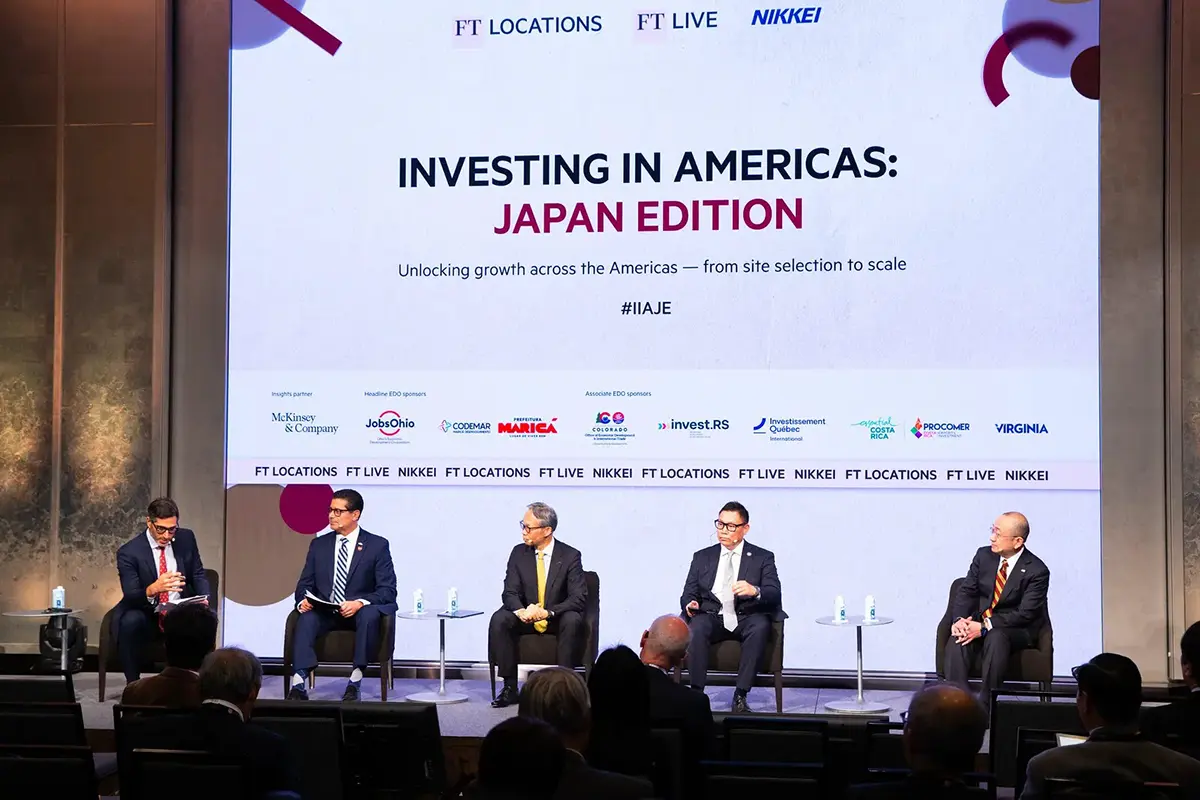
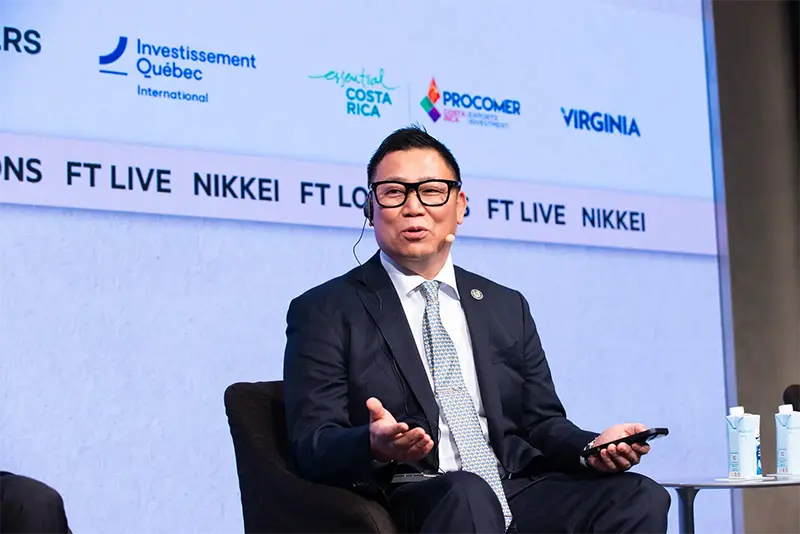
Announcing a U.S. investment takes a press release. Carrying it out takes a working bank account, a local address, a visa and a first hire, and each of those can hold a company up for months. On November 12, 2026, Toyokazu Yamaguchi, President & CEO of American Katerra, LLC, described that first year in detail at Investing in Americas: Japan Edition, a Financial Times event held in Tokyo.
Mr. Yamaguchi joined a panel titled “From Announcements to Execution” with J.P. Nauseef, President and CEO of JobsOhio, and speakers from Toray Industries and Kioxia. This recap covers what the panel discussed, what he shared about starting American Katerra in San Antonio, Texas, and what his experience suggests for other Japanese companies preparing to enter the U.S. market.
The topic carries weight for Japanese companies. Japan was the largest source of foreign direct investment in the United States in 2025 measured by ultimate beneficial owner, with a position of $827.1 billion, according to SelectUSA.
- Event: Investing in Americas: Japan Edition
- Date and venue: November 12, 2026, The Capitol Hotel Tokyu, Tokyo
- Organizers: FT Live, the events arm of the Financial Times, with Nikkei and FT Locations
- Session: “From Announcements to Execution”
- Speakers: J.P. Nauseef of JobsOhio, Toyokazu Yamaguchi of American Katerra, LLC, and speakers from Toray Industries and Kioxia, with a Financial Times moderator
From Announcements to Execution: What the Panel Discussed
The event looked at growth across the Americas, from site selection to scale. This session took up the part of that path that gets the least attention: what happens after an investment has been announced.
Mr. Nauseef opened with the view of an economic development organization. An announcement, he said, is only a beginning. The real challenge, in his account, is carrying out what follows: site preparation, power supply, permitting and workforce development.
The speakers from Toray Industries and Kioxia described how large manufacturers handle that phase. Their points included adapting to state and local rules as well as federal ones, making investment decisions in stages to absorb changes in cost, developing local leaders over many years, and recognizing that a U.S. site and a Japanese head office can weigh risks differently.
Mr. Yamaguchi spoke from a different position. Our parent company, Yamaguchi Heavy Industries Ltd., is a mid-sized steel fabricator in Japan, and American Katerra is its first overseas subsidiary. The company entered Texas on its own, and his remarks stayed with the practical details.
The First-Year Problem: A Bank Account, an Address and a Visa

The first obstacle he described was a chicken-and-egg problem between the bank account and the visa. After forming the U.S. company and depositing $1 million in capital, he found that without a Social Security number or a visa, the bank would release no more than $5,000. With the company’s own funds out of reach, even leasing an office was difficult.
He worked through it one step at a time. With help from a Japanese resident of San Antonio, he leased an apartment in one of the tallest buildings downtown, a recognizable address that helped establish credibility. The visa process took about a year and ended with the E-2 Treaty Investor visa issued in December 2025. A Texas driver’s license came later, as a separate step, and local hiring moved forward on its own schedule.
None of these steps is unusual. His account shows how much of a first year they can take, and how little of that work is visible in an investment announcement.
Public Support on Both Sides of the Pacific

Public programs in both countries helped. Mr. Yamaguchi said that selection for the hands-on support program connecting Tokyo and Texas, which we described in our recap of the Tokyo SME Support Center seminar, gave the company a network of government contacts in four major Texas cities: Dallas, Austin, San Antonio and Houston. In a state about 1.8 times the size of Japan, that reach matters.
Financing follows the same two-country approach. He explained that the company is working to raise investment funds from local banks by combining guarantee facilities from the Credit Guarantee Corporation of Tokyo, a public institution that guarantees loans for small and medium-sized enterprises, and the Texas Small Business Credit Initiative (TSBCI). TSBCI is run by the Texas Economic Development & Tourism Office within the Office of the Governor, is funded through the U.S. Treasury’s State Small Business Credit Initiative, and reaches businesses through participating lenders.
Hiring as an Unknown Company

American Katerra arrived in Texas as a company that no one there had heard of, and its recruiting reflects that. Mr. Yamaguchi said the company attends career fairs at local universities and community colleges and talks with students one at a time. Our visits to the University of Texas at San Antonio, Texas State University and Texas A&M University are part of the same effort, and current openings are listed on our Careers page.
Why the Texas Stock Exchange

Near the end of the session, the moderator asked what he would do to attract investment if he were a U.S. policymaker. Mr. Yamaguchi pointed to the Texas Stock Exchange (TXSE), the Dallas-based national securities exchange that began trading in July 2026. The exchange has said it expects to host initial public offerings from 2027. He restated American Katerra’s goal of listing on TXSE by 2030 after strengthening its governance, and described it as a “hole in one” that he intends to achieve together with the State of Texas, Bexar County, the City of San Antonio and the company’s supporters in Japan.
The moderator followed up by asking why he chose TXSE over the New York Stock Exchange or Nasdaq. His answer was that the Tokyo Stock Exchange, the NYSE and Nasdaq all have long histories, while TXSE is new, and that a new exchange is exactly where a young company can hold a big dream. A company that comes to Texas, he said, should grow together with Texas capital, and he called that the first important milestone.
The 2030 listing is a goal. Reaching it will depend on the company’s growth, its governance and the listing requirements that apply at the time.
Three Takeaways for Japanese Companies Entering the U.S. Market
Three points from his remarks apply well beyond steel.
- Plan for the administrative first year. A bank account, an address, a visa and a driver’s license are separate steps, and each takes its own time. In his case the visa alone took about a year.
- Use public programs in both countries. The Tokyo and Texas hands-on program opened doors across the state, and credit guarantee programs in Japan and Texas can support borrowing from local banks.
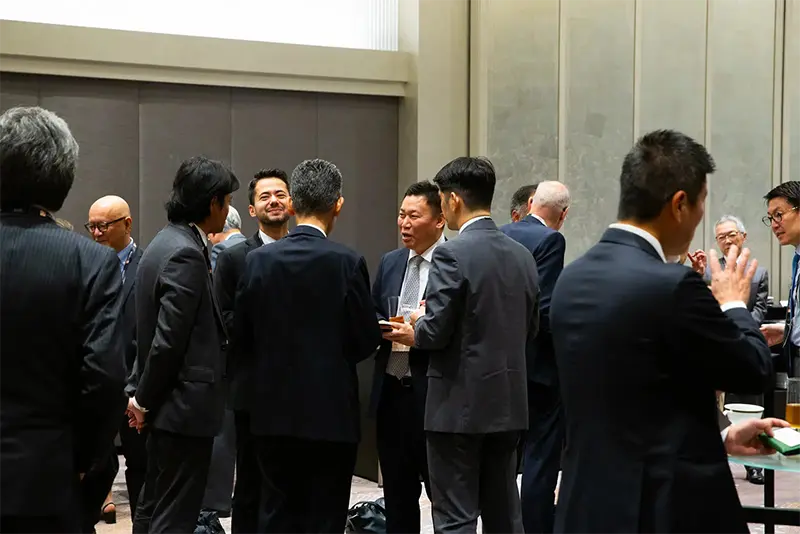
- Build the local network in person. Campus career fairs and working relationships with the city, the county and the state take time, and they are how an unknown company becomes a known one.
American Katerra provides structural steel fabrication for U.S. construction projects from San Antonio, and we went through each of these steps ourselves. If your company is preparing its first U.S. operation, or planning a plant, warehouse or other steel-framed building in Texas, contact our team. We are glad to share what the first year takes.
