Hydrogen Steel
Green, Blue, Pink, Turquoise, and White Hydrogen Steel™
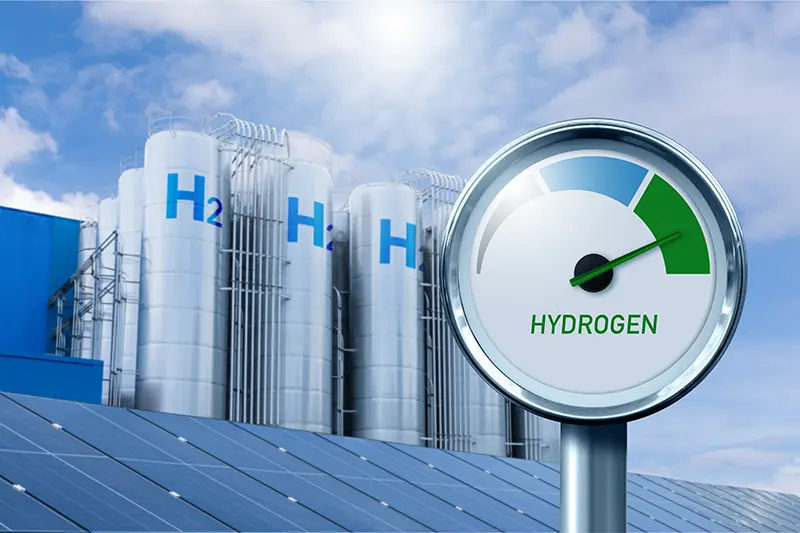
Five names, one route: steel made from iron that was reduced with hydrogen, with the source of the hydrogen written into the name.
Hydrogen steel is steel made from iron ore that was reduced with hydrogen in place of coke. The hydrogen takes the oxygen out of the ore and leaves water vapor where a blast furnace leaves CO2, and the resulting direct reduced iron is melted in an electric arc furnace. Hydrogen Steel is the research and development program under which American Katerra and our parent company, Yamaguchi Heavy Industries Ltd., define that steel and prepare to supply it, under five names, one for each way the hydrogen can be obtained: Green Hydrogen Steel™, Blue Hydrogen Steel™, Pink Hydrogen Steel™, Turquoise Hydrogen Steel™, and White Hydrogen Steel™. Blue Carbon Steel™, the concept and measurement procedure developed within the group, is the rule every tier follows. This page defines the program and the five names; detailed guides are linked where they are available.
What Is Hydrogen Steel?
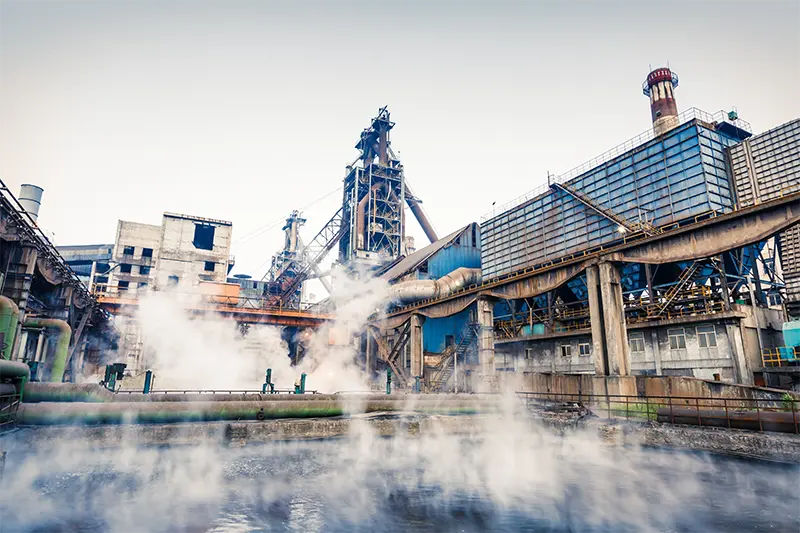
Nearly all ore-based steel today begins in a blast furnace, where coke made from coal strips the oxygen from iron ore and leaves CO2. Hydrogen steel replaces that step. In a direct reduction shaft furnace, hydrogen reacts with the ore to produce solid direct reduced iron (DRI) and water vapor; the DRI is then melted in an electric arc furnace (EAF), cast, and rolled like any other steel. The grades do not change: ASTM A992, A36, A572, and A500 are defined by chemistry and mechanical properties, and a section rolled from hydrogen-reduced iron has to meet the same specification as one rolled from scrap.
The difference is in the footprint. worldsteel’s latest route averages put the blast furnace route at 2.34 tonnes of CO2 per tonne of crude steel, natural-gas direct reduction with an EAF at 1.47, and scrap-based EAF at 0.69 (worldsteel, Sustainability Indicators 2025); SSAB’s HYBRIT process targets below 0.05 (SSAB), and the IEA defines near-zero-emission steel as 50 to 400 kg CO2e per tonne depending on scrap content (IEA, 2022). The furnace exists: the MIDREX H2 shaft furnace is designed to run on 100 percent hydrogen, and the first commercial plant of its kind is under construction in Boden, Sweden (Midrex). What does not yet exist at scale is cheap low-carbon hydrogen, which is why the source of the hydrogen matters as much as the furnace, and why we put it in the name.
The Five Colors of Hydrogen Steel
Hydrogen itself is colorless. The colors are industry shorthand for how the hydrogen was obtained (National Grid), and they are a label, not a measurement: two “blue” plants can have very different emissions depending on how much CO2 they capture, which is why the IEA calls the color terms impractical as a basis for contracts (IEA, April 2023). Our rule follows: the color tells you the source, the environmental product declaration (EPD) tells you the number, and no name goes on a steel package without the number behind it. We do not use grey, brown, black, or yellow as names. Other hydrogen sources can join the family as they are proven, under the same rule.
Green Hydrogen Steel™
Hydrogen source: Water electrolysis powered by renewable electricity
What sets the footprint: Electricity source, electrolyzer efficiency, EAF power
Where it stands (October 2026): First commercial plant under construction in Sweden; no U.S. plant
Trademark: Registered in Japan (No. 7088848)
Blue Hydrogen Steel™
Hydrogen source: Natural gas reforming with the CO2 captured and stored
What sets the footprint: Capture rate, upstream methane, storage integrity
Where it stands (October 2026): Hydrogen pipelines, CO2 storage, and natural-gas DRI exist on the Gulf Coast; no hydrogen DRI plant yet
Trademark: Registered in Japan (No. 7088849)
Pink Hydrogen Steel™
Hydrogen source: Electrolysis powered by nuclear electricity, or water splitting with reactor heat
What sets the footprint: Reactor power, electrolyzer efficiency, EAF power
Where it stands (October 2026): One small operating unit in New York; larger U.S. projects paused; Japan testing reactor heat
Trademark: Application in preparation
Turquoise Hydrogen Steel™
Hydrogen source: Methane pyrolysis: hydrogen plus solid carbon, no CO2 at the plant
What sets the footprint: Energy that drives the pyrolysis, upstream methane, fate of the carbon
Where it stands (October 2026): Pyrolysis hydrogen made in Nebraska and at a Texas pilot; one U.S. DRI pilot funded; no hydrogen steel plant
Trademark: Application in preparation
White Hydrogen Steel™
Hydrogen source: Natural (geologic) hydrogen extracted from underground accumulations
What sets the footprint: Drilling and processing energy, gas separation, leakage
Where it stands (October 2026): One small producing site in Mali; exploration in the U.S., France, Australia; no steel use yet
Trademark: Application in preparation
Green Hydrogen Steel™
Steel made from iron reduced with green hydrogen: hydrogen produced by electrolysis of water using renewable electricity, with the DRI melted in an EAF that also runs on low-carbon power. It is the tier with the lowest footprint and the one most people mean by “green steel” or “fossil-free steel.” Sweden is furthest along: Stegra’s Boden plant is funded and under construction with no first-steel date published (Canary Media, April 2026), and no U.S. plant exists, so early volumes will reach U.S. projects from European mills, often as environmental attribute certificates tied to a specific plant. Green Hydrogen Steel™ is a registered trademark of Yamaguchi Heavy Industries Ltd. in Japan (Registration No. 7088848) and is used as a trademark in the United States. Read the guide: Hydrogen Steel Explained.
Blue Hydrogen Steel™
Steel made from iron reduced with blue hydrogen: hydrogen produced from natural gas by reforming, with the CO2 captured and stored underground. The furnace and the chemistry are the same as the green tier; the footprint depends on the capture rate and on upstream methane, so it lands between natural-gas DRI and green. Its advantage is practical: it can be built where natural gas, pipelines, and CO2 storage already exist, and Texas, with one third of U.S. hydrogen output and more than 1,000 miles of hydrogen pipelines, names direct reduction of iron as an industrial use it wants to attract (Texas Railroad Commission, December 2024). Blue Hydrogen Steel™ is a registered trademark of Yamaguchi Heavy Industries Ltd. in Japan (Registration No. 7088849) and is used as a trademark in the United States. Read the guide: Hydrogen Steel Explained.
“Blue” appears in two of our names, with two roles. Blue Hydrogen Steel™ is the tier described here, named for the hydrogen color code: hydrogen made from natural gas with the CO2 captured and stored. Blue Carbon Steel™ is the concept and the measurement procedure behind the Hydrogen Steel program as a whole, and it applies to all five tiers. Blued steel and Blue Steel are unrelated: they describe a surface oxide finish and a knife steel. A specification should spell out which one it means.
Pink Hydrogen Steel™
Steel made from iron reduced with pink hydrogen: hydrogen produced by electrolysis powered by nuclear electricity, including variants that use reactor heat for high-temperature electrolysis or thermochemical water splitting (sometimes called purple or red). The IEA puts hydrogen from nuclear-powered electrolysis at 0.1 to 0.3 kg of CO2e per kg, against about 11 kg for unabated natural gas (IEA, April 2023), so this tier is comparable to green. The United States has one small operating unit, at Constellation’s Nine Mile Point plant in New York (Constellation, March 2023), and Japan aims to make hydrogen with heat from its HTTR test reactor by 2030 (JAEA, March 2025). Pink Hydrogen Steel™ is a trademark of Yamaguchi Heavy Industries Ltd.; a trademark application is being prepared.
Turquoise Hydrogen Steel™
Steel made from iron reduced with turquoise hydrogen: hydrogen produced by methane pyrolysis, in which natural gas or biomethane is split at high temperature into hydrogen and solid carbon. No CO2 is formed at the plant; the carbon comes out as carbon black or graphite that can be sold or stored as a solid, and the footprint depends on the energy that drives the pyrolysis and on upstream methane (University of Victoria IESVic, August 2025). No steelmaker yet reduces iron this way, but a U.S. pilot direct reduction furnace fed by pyrolysis hydrogen has Department of Energy funding with U.S. Steel (Steel Times International, July 2024), and the hydrogen itself is being made in Texas, at a pilot in San Antonio and a planned BASF and ExxonMobil demonstration plant at Baytown (BASF, November 2025). Turquoise Hydrogen Steel™ is a trademark of Yamaguchi Heavy Industries Ltd.; a trademark application is being prepared.
White Hydrogen Steel™
Steel made from iron reduced with white hydrogen, also called natural or geologic hydrogen: hydrogen that forms underground when water reacts with iron-rich rock or is split by natural radiation, and accumulates in the subsurface (USGS). It is extracted, not manufactured, so its footprint comes from drilling, from separating the hydrogen from nitrogen, methane, and helium, and from leakage. The U.S. Geological Survey estimates the subsurface may hold on the order of 5.6 trillion tonnes, most of it impractical to recover (USGS, Science Advances, December 2024); the only commercial production today is a small field in Mali, about 5 tonnes a year, and the IEA does not expect natural hydrogen to contribute meaningfully before 2030 (IEA, Global Hydrogen Review 2025). Exploration is under way in Kansas, Iowa, France, and Australia, with iron ore miner Fortescue holding 39.8 percent of the Kansas explorer HyTerra (HyTerra, September 2024) and Osaka Gas and Mitsubishi Heavy Industries Americas among the investors in Koloma (Koloma, October 2024). No steelmaker uses it yet. White Hydrogen Steel™ is a trademark of Yamaguchi Heavy Industries Ltd.; a trademark application is being prepared. It is unrelated to the Japanese knife steel known as White Steel.
What a Hydrogen Steel Name Means on Your Project
- The grades, welding procedures, coatings, and detailing do not change. The reductant changes the emissions of ironmaking; the mill certification and design values stay the same.
- The documentation is the EPD. Buy Clean California caps hot-rolled sections at 1,010 kg CO2e per tonne unfabricated and 1,080 fabricated (California DGS), Colorado’s 2026 limit for fabricated hot-rolled steel is 1,220 (Colorado OSA, January 2026), and LEED v5 made quantifying embodied carbon a prerequisite (USGBC, 2025). A hydrogen steel name without a facility-specific EPD is a label without a number.
- Know which of three things you are buying. Physical hydrogen-route steel whose own EPD shows the reduction, a mass-balance allocation, or environmental attribute certificates sold alongside conventional steel. Only the first changes the number in your building’s life cycle assessment without a methodology footnote. Our guide lists the six questions to ask before you specify “green” steel.
How American Katerra Uses These Names
American Katerra, LLC is the U.S. subsidiary of Yamaguchi Heavy Industries Ltd. and applies the group’s Green & Blue Carbon Steel™ approach to structural steel packages in the United States. The approach pairs two concepts with the work that follows from them. Green Carbon Steel™ is the concept of reducing CO2 across the steel supply chain, and Green Steel is the product you can specify today, made from recycled scrap in electric arc furnaces with embodied-carbon documentation. Blue Carbon Steel™ is the concept and the measurement procedure for steel whose iron is reduced with hydrogen in place of coke, setting out how the carbon of each tier is measured and disclosed, and Hydrogen Steel is the research and development program that applies it. The five names are its tiers, each tied to a disclosed hydrogen source.
No tier of Hydrogen Steel can be ordered for a U.S. project this quarter, which is why it sits under Research & Development on this site: a name should never do the work the steel has not done yet. What we can do today is measure: an embodied-carbon baseline for your steel package with life cycle assessment and GHG calculation, scrap-EAF sections with facility-specific EPDs, embodied-carbon reporting in the format a Buy Clean program or LEED v5 submission needs, and the mill test reports that tie each heat to its origin. When hydrogen-route steel of any color reaches U.S. projects, the tier that can be supplied moves to our Products under its name, the same LCA model will show what it changes, and the same traceability will prove which name applies.
Trademark notice. Green Hydrogen Steel™ and Blue Hydrogen Steel™ are registered trademarks of Yamaguchi Heavy Industries Ltd. in Japan (Registration Nos. 7088848 and 7088849). Pink Hydrogen Steel™, Turquoise Hydrogen Steel™, and White Hydrogen Steel™ are trademarks of Yamaguchi Heavy Industries Ltd. All five are used as trademarks in the United States; no U.S. registration is claimed. Hydrogen Steel is the name of the program under which the five are developed and will be supplied; “hydrogen steel” and the hydrogen color terms are generic industry terms and are used here descriptively.
Hydrogen Steel FAQs

What is hydrogen steel?
Hydrogen steel is steel made from iron that was reduced from ore using hydrogen in place of coke. The reaction releases water vapor in place of CO2, and the direct reduced iron is melted in an electric arc furnace. With low-carbon hydrogen and low-carbon electricity, the route can bring ore-based steel from the blast furnace average of 2.34 tonnes of CO2 per tonne down to the near-zero range of 50 to 400 kg.
What do green, blue, pink, turquoise, and white mean in a hydrogen steel name?
They name the source of the hydrogen: water electrolysis with renewable electricity (green), natural gas with the CO2 captured and stored (blue), nuclear electricity or heat (pink), methane pyrolysis that yields solid carbon in place of CO2 (turquoise), and natural hydrogen extracted from underground accumulations (white). The furnace and the steel grades are the same in all five.
Can I buy hydrogen steel in the United States today?
Not yet. As of October 2026, no commercial hydrogen-based ironmaking operates in the United States, and early volumes will come from Europe, often as environmental attribute certificates tied to a specific plant. That is why Hydrogen Steel is listed under Research & Development: a specification can already name the tier and the documentation it requires, and the availability of each tier is stated on this page and updated as it changes. For a U.S. structural package today, the practical low-carbon option is domestic scrap-EAF steel backed by a facility-specific EPD, which is what our Green Steel scope supplies.
Is hydrogen steel as strong as conventional steel, and does it cause hydrogen embrittlement?
Yes to the first and no to the second. Grades such as ASTM A992 or A36 are defined by chemistry and mechanical properties, and hydrogen-reduced iron melted and rolled to those specifications meets them. The hydrogen is used in the ironmaking step; the direct reduced iron is then melted in an electric arc furnace, where dissolved gases are controlled as for any other steel. Hydrogen embrittlement is a separate issue for high-strength steels exposed to hydrogen in processing or service, such as pickling, plating, or sour-gas environments, and it is managed by the same specifications whatever route made the iron.
Is hydrogen steel the same as “low carbon steel”?
No. In metallurgy, low carbon steel means steel with a low carbon content, typically 0.30 percent or less, which describes most structural grades. Hydrogen steel, like low-emission or low-embodied-carbon steel, refers to the CO2 released in making it, reported in an EPD as kg CO2e per tonne. A specification should say which meaning it intends and name the threshold.
How is Hydrogen Steel related to Blue Carbon Steel™?
Blue Carbon Steel™ is the concept and the measurement procedure; Hydrogen Steel is the research and development program that applies it. Blue Carbon Steel™ sets out how steel whose iron is reduced with hydrogen in place of coke is measured and disclosed, tier by tier, and Hydrogen Steel is where that work is done: one program, five names that tell you where the hydrogen came from, and the names the steel will carry when it can be supplied. It mirrors the pair on the green side, where Green Carbon Steel™ is the concept and Green Steel is the product you can buy today.
Inquiries About Hydrogen Steel
If your project has an embodied-carbon target, a Buy Clean requirement, or a LEED v5 submission, send us the drawings. We will return an embodied-carbon estimate for the steel package, the EPD documentation behind it, and a clear statement of what can be sourced today under our Green Steel scope, and of what the Hydrogen Steel tiers would change when they become available to U.S. projects. Contact our team to start.