

Project specs are asking for carbon numbers earlier, owners want EPDs attached to structural bids, and green building credits reward teams that can document reductions instead of describing intentions. Life cycle assessment has moved from an academic exercise to a procurement requirement, and steel, as one of the largest contributors to a building’s embodied carbon, sits at the center of it. This guide explains what life cycle assessment is, how the stages and system boundaries work, why it matters for steel construction now, and what to expect when you engage LCA services for a project.
What Is Life Cycle Assessment?

Life cycle assessment (LCA), also called life cycle analysis, is a standardized method for quantifying the environmental impacts of a product or system across its life, from raw material extraction through manufacturing, use, and end of life. The framework is defined by ISO 14040 and ISO 14044, which is why two LCAs done properly can be compared, audited, and used in procurement decisions.
An LCA is broader than a carbon footprint. A carbon footprint tracks one impact category, global warming potential (GWP), while a full LCA can also cover categories such as acidification, eutrophication, and resource depletion. In construction practice, most of the attention lands on GWP, because that is the number behind the term embodied carbon: the emissions locked into materials before a building ever turns on the lights. When a spec references LCA data for structural steel, it is almost always asking about embodied carbon first.
The Four LCA Stages

Every LCA moves through the same four stages defined by ISO 14040. First, goal and scope: what question the study answers, the functional unit (for example, one ton of fabricated structural steel), and the system boundary. Second, life cycle inventory (LCI): collecting the input and output data, energy, materials, transport, waste, for every process inside the boundary. Third, life cycle impact assessment (LCIA): translating that inventory into impact categories such as GWP. Fourth, interpretation: identifying hotspots, testing sensitivities, and turning the numbers into decisions. The process is iterative; a first pass often reveals data gaps that tighten the second.
System Boundaries: Cradle to Gate vs. Cradle to Grave

System boundaries decide what your numbers include, and they are where most LCA confusion starts. In building work the boundary language follows EN 15978 modules. A1 to A3 cover the product stage, raw material supply, transport to the factory, and manufacturing, and together they are called cradle to gate. Add A4 and A5, transport to site and construction, and you have cradle to site or cradle to practical completion. Module B covers use, C covers end of life, and module D reports benefits beyond the system, such as reuse and recycling, where steel’s high recyclability tells strongly in its favor.
Most product EPDs for steel report cradle to gate, because that is where mill and fabrication data live and where the largest share of embodied carbon typically concentrates. Whole-building studies extend further. Knowing which boundary a number describes is the first question to ask whenever two carbon figures are compared.
Why LCA Matters in Steel Construction Now

Three forces pushed LCA into the structural steel workflow. First, owners with public climate commitments now flow those commitments down into design briefs and purchasing standards. Second, green building rating systems award credits for whole building life cycle assessment and for choosing products with environmental product declarations, which makes documented LCA data worth real points in certification. Third, low-carbon procurement policies, the Buy Clean pattern adopted by several states and reflected in federal low-embodied-carbon programs, increasingly require EPDs for structural materials in public work.
The practical consequence for GCs and fabricators is simple: carbon data requests are arriving earlier, at bid stage rather than closeout, and teams that can produce credible numbers quickly are easier to award. LCA readiness is becoming an eligibility question, not a marketing one.
A Life Cycle Assessment Example: A Structural Steel Package

Consider a simplified example for a fabricated steel package. The functional unit is one metric ton of fabricated structural steel delivered to site. For A1, the largest single input is the steel itself, so the study starts from mill data, ideally a mill-specific EPD rather than an industry average, because mill routes differ substantially in carbon intensity. A2 covers transport from mill to shop, driven by distance and mode. A3 is the fabrication stage: shop energy for cutting, welding, and handling, consumables, and scrap rates. A4 adds transport to site, and A5 the erection stage if the boundary extends that far.
Interpreting a study like this almost always finds the same hotspot: the A1 material stage dominates, which means mill selection and the specificity of mill EPDs move the total more than anything else. Fabrication data then refines the picture, and this is where record quality matters, energy per ton processed, traceability of each member back to its heat number, and quantities taken from the model rather than estimated. The better the fabricator’s data discipline, the smaller the error bars on the final number.
Whole Building LCA vs. Product LCA
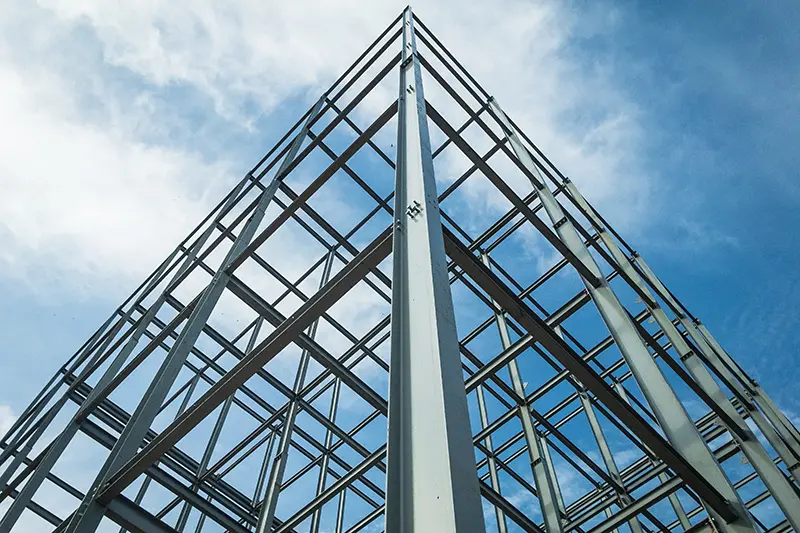
A product LCA, usually published as an EPD, describes one material or product. A whole building life cycle assessment aggregates products across every assembly and models the building over a defined service life, which is what rating system credits and owner comparisons typically require. The two are complementary: whole-building results are only as good as the product data feeding them, and the steel package is often one of the largest line items. The leverage is greatest early, when frame options, spans, and material choices are still open.
Where Fabricator Data Makes or Breaks Your LCA
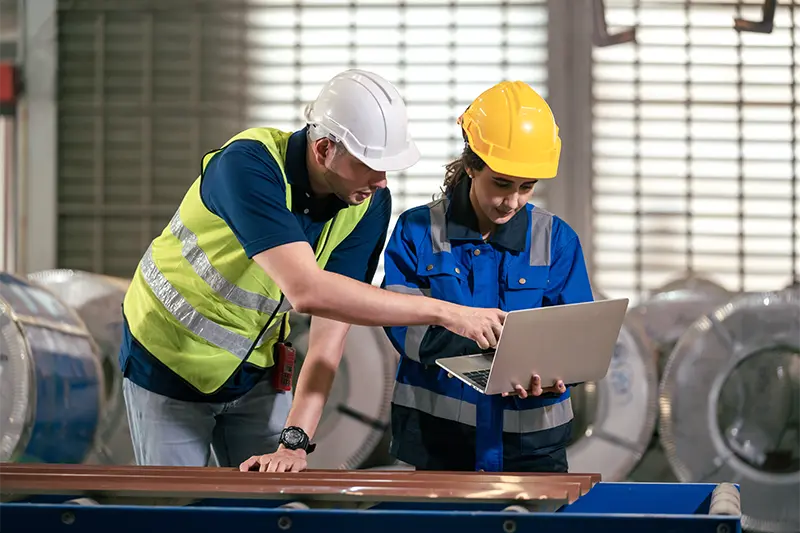
LCA has a garbage-in problem: an elegant model built on generic assumptions produces confident-looking numbers that will not survive an audit or a comparison. What good looks like on the fabrication side is concrete. Material traceability from mill certs down to heat numbers, managed through disciplined supply chain records. Mill-specific EPDs collected at procurement, not reconstructed afterward. Shop energy accounted against production. Quantities taken directly from the BIM model, which is the idea behind our Green Information Modeling approach, carbon data carried alongside geometry in the same model that fabricates the steel. And where the project targets lower embodied carbon, sourcing options such as our Green Carbon Steel™ approach and documented embodied-carbon reporting for the fabricated package.
American Katerra provides LCA services built on exactly that foundation, model-based quantities, traceable materials, and fabrication data, so the numbers you take into a bid or a certification review hold up under questions.
What to Expect from LCA Services
A typical LCA services engagement runs in five steps. Scope definition: agreeing the goal, functional unit, and boundary, cradle to gate or beyond. A data collection plan: what comes from mills, what comes from the shop, what comes from the design model. Modeling and impact assessment against ISO 14040 and 14044. Documentation: a report your reviewer can audit, EPD support where a declaration is the goal, and credit documentation where certification is. And iteration: rerunning options so design decisions can be compared on carbon before they are locked. Timelines scale with the boundary, which is one more reason to start the conversation at bid stage rather than after award.
FAQ: Life Cycle Assessment
What is life cycle assessment in simple terms? It is a standardized way to measure the environmental impact of a product across its whole life, from raw materials to end of life, so that choices can be compared with numbers instead of claims.
What is the difference between LCA and a carbon footprint? A carbon footprint measures one impact, greenhouse gas emissions. An LCA can measure several impact categories, and in construction it is the method behind credible embodied carbon numbers.
What does cradle to gate mean? It is the system boundary covering modules A1 to A3, raw material supply, transport, and manufacturing, everything that happens before the product leaves the factory gate. Most steel EPDs report on this boundary.
Talk to Our LCA Team
If a bid is asking for embodied carbon numbers, a certification target needs a whole building LCA, or you want EPD-grade data for a fabricated steel package, our team can scope it with you and give you a realistic timeline. Start the conversation here or learn more about our LCA services.