If you buy structural steel for a living, the phrase “hydrogen steel” has probably reached your inbox at least once this year, usually attached to a European plant announcement or a data center procurement story. The term is real, the technology is real, and the timelines are longer than the headlines suggest. This guide explains what hydrogen steel is, how Green Hydrogen Steel™ and Blue Hydrogen Steel™ differ, where hydrogen-based steelmaking stands in Europe, Japan, and the United States as of October 2026, and what any of it changes for a steel package you are pricing today.
It is also a note on names. On October 1, 2026, the Japan Patent Office registered Green Hydrogen Steel™ and Blue Hydrogen Steel™ as trademarks of Yamaguchi Heavy Industries Ltd., the parent company of American Katerra, LLC. In the United States, American Katerra uses the names as trademarks (™) for the hydrogen-route tiers of the group’s decarbonization roadmap, alongside Green Carbon Steel™ and Blue Carbon Steel™. We will be specific about what those names describe today and what they do not.
What Is Hydrogen Steel?
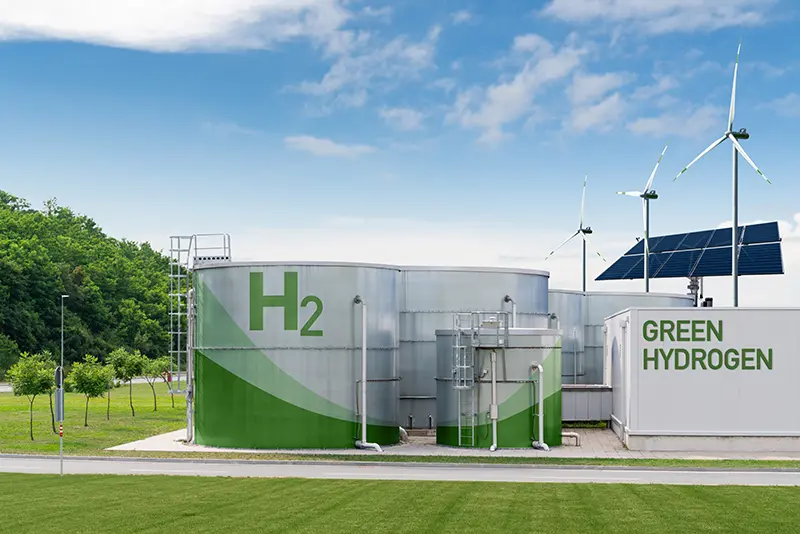
Hydrogen steel is steel whose iron was reduced from ore with hydrogen in place of coal-derived coke. In the conventional blast furnace route, coke strips oxygen from iron ore and leaves the furnace as carbon dioxide. In hydrogen direct reduction (H2-DRI), hydrogen does the same job inside a shaft furnace and leaves as water vapor. The product, direct reduced iron or its compacted form, hot briquetted iron (HBI), is then melted in an electric arc furnace (EAF), often together with scrap. When the furnace runs on low-carbon electricity, the process emissions of primary steelmaking fall toward zero.
The scale of the change is visible in the route averages. worldsteel’s latest indicators (2024 data) put the blast furnace and basic oxygen furnace route at 2.34 tonnes of CO2 per tonne of crude steel, natural-gas DRI with an EAF at 1.47, and scrap-based EAF at 0.69, against a global average of 1.92 (worldsteel, Sustainability Indicators 2025). Hydrogen DRI replaces the largest single source in that first number. SSAB’s HYBRIT route targets below 0.05 tonnes of CO2e per tonne of steel (SSAB), and the contract that Mercedes-Benz signed with H2 Green Steel, now Stegra, specified 0.4 tonnes per tonne (ICCT, September 2024). The International Energy Agency defines near-zero-emission steel as 50 to 400 kg of CO2e per tonne depending on how much scrap goes into it (IEA, 2022).
The equipment exists. The MIDREX H2 shaft furnace is designed to run on 100 percent hydrogen, and the first commercial plant of that kind, Stegra’s 2.1 million tonne per year direct reduction plant in Boden, Sweden, is under construction (Midrex). What does not yet exist at scale is cheap low-carbon hydrogen, which is why the color of the hydrogen matters as much as the furnace.
Two look-alike terms that mean something else
- “Low carbon steel” in metallurgy describes carbon content, usually 0.30 percent or less, and has nothing to do with emissions. ASTM A992 wide-flange shapes and A36 plate are both low carbon steels in that sense, whatever furnace made them. Emissions are described as low-emission, low-embodied-carbon, or near-zero steel, measured in kg of CO2e per tonne.
- “Hydrogen embrittlement” is a cracking mechanism in high-strength steel and fasteners exposed to hydrogen in service. It is a materials engineering topic, unrelated to using hydrogen as a reductant in ironmaking.
Green Hydrogen Steel™ vs. Blue Hydrogen Steel™: The Color Code Behind the Names
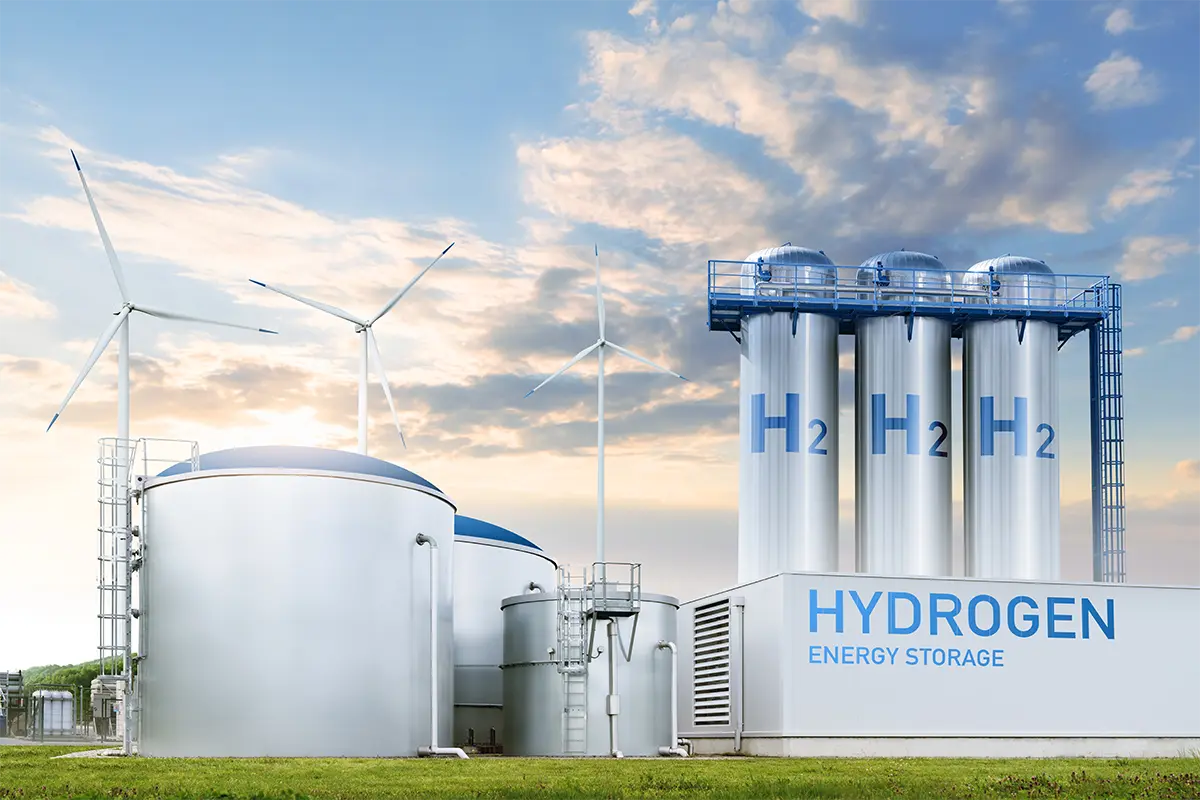
Hydrogen itself is colorless. The colors are shorthand for how it was made. Green hydrogen is produced by electrolysis of water using renewable electricity. Blue hydrogen is produced from natural gas by reforming, with the resulting CO2 captured and stored. Grey hydrogen is the same reforming process without capture, and it is how nearly all hydrogen is made today. Turquoise (methane pyrolysis) and pink (nuclear-powered electrolysis) complete the spectrum (National Grid).
Regulators increasingly set thresholds in numbers, which buyers should prefer to colors. The U.S. Department of Energy’s Clean Hydrogen Production Standard targets 4.0 kg of CO2e per kg of hydrogen on a well-to-gate basis (DOE); the top tier of the U.S. Section 45V credit requires less than 0.45 kg (26 U.S.C. 45V); Japan’s low-carbon hydrogen support uses 3.4 kg (Mondaq, June 2024). ISO/TS 19870 and ISO 14067 define how that carbon intensity is calculated (ISO).
Applied to steel, the two names work like this:
- Green Hydrogen Steel™ is steel whose iron was reduced with green hydrogen and melted with low-carbon electricity. It is the lowest-emission route known for ore-based (primary) steel, and the route behind the Swedish projects.
- Blue Hydrogen Steel™ uses the same reduction chemistry with blue hydrogen. Its footprint depends on the capture rate and on upstream methane, so it lands between the natural-gas DRI figure and the green figure. Its advantage is practical: it can be built where natural gas, pipelines, and CO2 storage already exist, which describes the U.S. Gulf Coast better than any other place in the world.
| Route | Indicative CO2 intensity (t per t crude steel) | Basis |
|---|---|---|
| Blast furnace + basic oxygen furnace (BF-BOF) | 2.34 | worldsteel 2024 route average |
| Natural-gas DRI + EAF | 1.47 | worldsteel 2024 route average |
| Scrap-based EAF | 0.69 | worldsteel 2024 route average (U.S. facility EPDs often lower) |
| Blue hydrogen DRI + EAF | Between 1.47 and the green figure, depending on capture rate | No published industry average yet |
| Green hydrogen DRI + EAF with low-carbon power | About 0.05 to 0.4 | SSAB HYBRIT target; Stegra/Mercedes-Benz contract |
One word, two meanings. On this site, the “Blue” in Blue Carbon Steel™ comes from blue carbon, the carbon stored by coastal and marine ecosystems, and describes ideas for capturing and offsetting fabrication emissions. The “Blue” in Blue Hydrogen Steel™ comes from the hydrogen color code above. Neither is related to “blued steel,” the black-oxide finish on firearms and tools, or to the “Blue Steel” grades used in Japanese knife making.
Where Hydrogen Steel Stands Around the World (October 2026)
Europe built the first plants and is now resetting the timelines
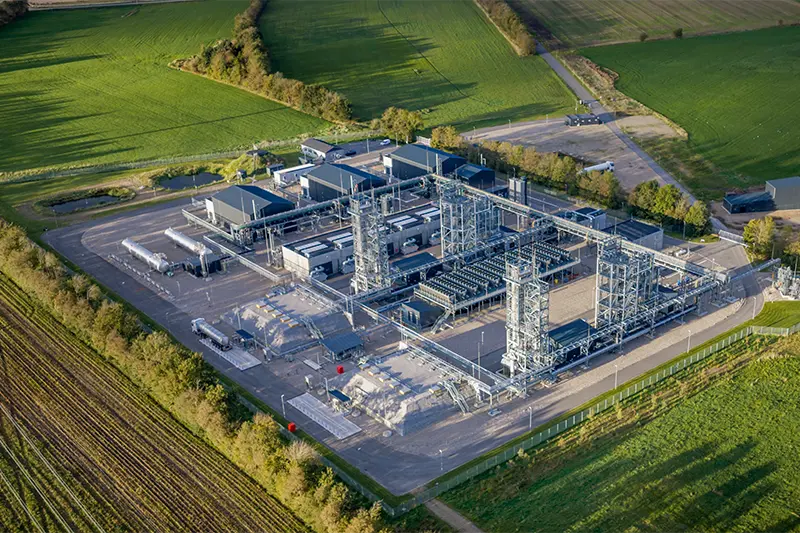
Sweden is furthest along. Stegra closed a EUR 1.4 billion financing round in June 2026 to complete its Boden plant, installed its final electrolyzer module in April, and appointed a new CEO on September 30, 2026 after a 100-day review by its new owners (Stegra). During the fundraising its CEO at the time said steel production would follow 18 to 24 months after the facility is finished, and the company has not published a first-steel date (Canary Media, April 2026). SSAB, whose HYBRIT process produced the first hydrogen-reduced steel in 2021, reported in May 2026 that commissioning of its new electric arc furnace in Oxelösund is delayed by grid-connection permitting (SSAB, May 2026).
Germany and France have slowed. thyssenkrupp’s 2.5 million tonne per year direct reduction plant in Duisburg may initially operate without hydrogen after the company called the original requirement unrealistic for start-up (SteelOrbis, August 2026). ArcelorMittal cancelled its DRI-EAF projects in Bremen and Eisenhüttenstadt in June 2025, citing the policy and market environment, while continuing EAF investments (Argus, June 2025). Salzgitter now expects the first stage of SALCOS to produce in 2027 and has pushed its later stages back by about three years (EUROMETAL, September 2025). The common thread is cost: Fastmarkets estimates that hydrogen DRI-EAF production costs are currently nearly twice those of a blast furnace, with the gap narrowing to about 7 percent by 2035 (Fastmarkets, March 2026).
Asia: hydrogen-rich gas in China, pilots in Korea
China operates the largest DRI plants that use hydrogen, but the hydrogen is recovered from coke oven gas. Baosteel’s 1 million tonne per year Zhanjiang plant and HBIS’s 600,000 tonne Zhangjiakou plant both run on hydrogen-enriched gas from existing steelworks (GMK Center). In Korea, POSCO received approval in April 2026 for the site of its 300,000 tonne HyREX hydrogen reduction pilot, with commissioning targeted for 2028 (SteelOrbis, April 2026).
Japan: a blast furnace centered path with strong policy support
Japan makes 74 percent of its steel in blast furnaces (worldsteel, World Steel in Figures 2026), so its hydrogen strategy starts inside the furnace. Nippon Steel’s Super COURSE50 program, which injects heated hydrogen into a 12 cubic meter test blast furnace in Kimitsu, reached a 43 percent CO2 reduction in late 2024, the first result above 40 percent reported anywhere (Nippon Steel, December 2024). The company’s roadmap pairs that blast furnace work with a 60 meter experimental hydrogen direct reduction shaft furnace at its Hasaki Research and Development Center, with operational tests scheduled to begin in fiscal 2025 and commercial-scale hydrogen direct reduction targeted by around 2040, on the way to carbon neutrality in 2050 (Nippon Steel, Carbon Neutral Vision 2050).
The policy side is built to pay for it. Japan’s Hydrogen Society Promotion Act, passed in May 2024, provides contract-for-difference support that covers the price gap between low-carbon hydrogen and fossil fuels for up to 15 years, with JPY 3 trillion budgeted (Mondaq, June 2024). In the meantime, Japanese mills sell low-CO2 steel under a mass balance approach: reductions achieved somewhere in the works are certified and allocated to selected products such as Nippon Steel’s NSCarbolex Neutral, JFE’s JGreeX, and Kobe Steel’s Kobenable Steel, with third-party assurance of the calculation in JFE’s case (JFE Steel; Renewable Energy Institute, October 2025). The physical beam’s own footprint does not change under mass balance, which is the detail a buyer needs to understand before comparing offers.
Standards, and what the word “green” is allowed to mean
There is still no official definition of green steel; SSAB says as much on its own website (SSAB). What exists instead is a set of intensity-based scales. The IEA near-zero range is 50 to 400 kg CO2e per tonne. ResponsibleSteel’s Decarbonisation Progress Levels grade a site on a sliding scale that tightens as scrap content rises, so that high-scrap EAF steel and ore-based steel are compared fairly (ResponsibleSteel, September 2024). Germany’s Low Emission Steel Standard (LESS), launched in April 2024, classes steel from A to E using carbon intensity and scrap content (EUROMETAL, April 2024).
Two European rules now apply to the word itself. The EU Carbon Border Adjustment Mechanism entered its definitive phase on January 1, 2026, and covers iron and steel (European Commission). Separately, Directive (EU) 2024/825 applies from September 27, 2026: it prohibits generic environmental claims such as “green” or “climate friendly” unless the trader can demonstrate recognized excellent environmental performance, treats product and brand names as claims, and bans claims that a product is carbon neutral on the basis of offsets (EUR-Lex, Directive 2024/825). Any steel brand with “green” in its name that sells into Europe now has to carry the data to back the word. That is a useful discipline everywhere.
The U.S. Picture: Scrap, Natural Gas, and a Reset on Hydrogen
U.S. steel is already the low-emission outlier
The United States made 71.3 percent of its crude steel in electric arc furnaces in 2025, against 30.3 percent worldwide and 25.8 percent in Japan (worldsteel, World Steel in Figures 2026). Domestic hot-rolled wide-flange sections are made from about 93 percent recycled scrap in electric arc furnaces, and about 90 percent of the environmental impact of fabricated structural steel occurs before the steel leaves the mill (Modern Steel Construction, June 2021).
The numbers buyers actually see are in Environmental Product Declarations (EPDs). The AISC industry-wide EPD for hot-rolled structural sections reports 1,010 kg CO2e per tonne at the mill gate, the figure California adopted as its Buy Clean limit (California DGS, 2025). Facility-specific declarations run lower: Steel Dynamics’ Columbia City structural mill published 664 kg CO2e per tonne (A1 to A3) in October 2025 (Steel Dynamics EPD). In other words, the beam you specify today in the United States already sits far below the blast furnace world average, without any hydrogen. Hydrogen matters most for primary, ore-based steel: plate, heavy sections from integrated mills, and the imported steel that Section 232 tariffs, at 50 percent since June 2025, now make expensive (CBP, June 2025).
Hydrogen ironmaking in the U.S. is on pause
The three U.S. direct reduction plants, Nucor Steel Louisiana, Cleveland-Cliffs Toledo, and ArcelorMittal Texas HBI near Corpus Christi (2 million tonnes per year), all run on natural gas (ArcelorMittal). The one funded hydrogen-ready project changed course this summer. On August 21, 2026, Cleveland-Cliffs and the Department of Energy announced that the $500 million federal award for Middletown Works will fund a blast furnace rebuild, material handling, and cogeneration in place of the hydrogen-ready DRI plant selected in 2024; DOE’s release quotes the company as saying the original scope no longer made business sense because customers would not pay a green premium (DOE, August 2026). SSAB had already withdrawn from negotiations for a hydrogen ironmaking plant in Mississippi in January 2025 (DOE Industrial Demonstrations Program). As of October 2026 there is no commercial hydrogen-based ironmaking in the United States, operating or funded.
Federal hydrogen policy has narrowed to the projects that can move fastest. The Section 45V production credit survives, but after the July 2025 budget law a facility must begin construction before January 1, 2028 to qualify, five years earlier than before (26 U.S.C. 45V). The Section 45Q carbon capture credit, the one that underwrites blue hydrogen, was kept, with storage and utilization now paid at the same rate (26 U.S.C. 45Q). On October 1, 2025, DOE terminated 223 awards including the California and Pacific Northwest hydrogen hubs (DOE, October 2025; E&E News), while the Gulf Coast HyVelocity hub, selected for up to $1.2 billion and built around both electrolysis and natural gas with carbon capture, remained listed by DOE, with its funding reported to be under review (DOE, Gulf Coast Hydrogen Hub).
Why Texas is a blue hydrogen story
Texas produces 3.6 million tonnes of hydrogen a year, one third of the U.S. total, and operates more than 1,000 miles of dedicated hydrogen pipelines, nearly twice the mileage of every other state combined. The state’s Hydrogen Production Policy Council, created under HB 2847, names direct reduction of iron with clean hydrogen as one of the industrial uses it wants to attract (Texas Railroad Commission, December 2024). Almost all of today’s volume is grey hydrogen for refineries and chemical plants. The conversion to blue is the pending step: ExxonMobil’s Baytown project, designed for up to 1 billion cubic feet per day of hydrogen from natural gas with more than 98 percent of the CO2 captured, was still waiting on firm offtake before a final investment decision as of August 2025 (Argus, August 2025).
That is the logic behind keeping two names. Where cheap renewable electricity exists, as in northern Sweden, Green Hydrogen Steel™ is the route. Where natural gas, pipelines, and geologic storage exist, as on the Gulf Coast, Blue Hydrogen Steel™ is the route that can be built first. A steel fabrication provider based in San Antonio sits about 200 miles from the largest hydrogen pipeline network in the country, inside the state most likely to supply blue hydrogen at scale.
What Hydrogen Steel Changes for Your Steel Package, and What It Does Not
The grades do not change. ASTM A992, A36, A572, and A500 are defined by chemistry and mechanical properties, and a W14x90 rolled from hydrogen-reduced iron has to meet the same specification as one rolled from scrap. Welding procedures, coatings, detailing, and erection are unaffected. What changes is the documentation, the price, and the questions you need to ask.
The documentation is the EPD. Buy Clean California requires facility-specific, ISO 14025 Type III EPDs and sets limits effective January 1, 2025 of 1,010 kg CO2e per tonne for unfabricated hot-rolled sections (1,080 fabricated), 1,710 for HSS, 1,490 for plate, and 755 for rebar (California DGS). Colorado’s 2026 limit for fabricated hot-rolled steel is 1,220 (Colorado OSA, January 2026). The federal Buy Clean program was rescinded on January 20, 2025 when Executive Order 14154 revoked the order that created it (White House, January 2025), so the pressure now comes from states, from LEED v5, which launched in 2025 with a prerequisite to quantify embodied carbon (USGBC, 2025), and from private buyers. RMI’s Sustainable Steel Buyers Platform, which pools demand from large purchasers for North American near-zero steel, estimates that demand could reach 6.7 million tons a year in the United States by 2030 (RMI), and Microsoft signed a seven-year agreement with Stegra in September 2025 for near-zero steel attributes tied to its data centers (Stegra, September 2025).
The premium is real but narrower than it looks. Stegra’s early customers agreed to pay 20 to 30 percent more under five to seven year take-or-pay contracts (Hydrogen Economist, February 2024). The World Economic Forum models a 35 to 70 percent premium for clean-hydrogen primary steel and estimates the pass-through to a finished building at roughly 2 percent of cost (WEF, 2023). On a structural package, the steel is a fraction of the frame cost and the frame is a fraction of the building, which is why owners with embodied-carbon targets have been willing to pay it.
Know which of three things you are buying. Offers labeled low-carbon, green, or net zero arrive in three forms: physical route steel, where the beam itself was made the low-emission way and its EPD shows it; mass-balance allocations, where certified reductions from elsewhere in a works are assigned to your order and the beam’s own EPD is unchanged; and environmental attribute certificates or offsets sold alongside conventional steel. Each has a legitimate use. Only the first changes the number in your building’s life cycle assessment without a methodology footnote.
Six questions to ask before you specify “green” steel
- Which route produced the iron: scrap EAF, natural-gas DRI, or hydrogen DRI, and where was it melted and poured?
- Can you provide a facility-specific EPD for the exact product, and what is the A1 to A3 global warming potential in kg CO2e per tonne?
- Is the reduction physical, mass-balance allocated, or certificate based, and who verified it?
- Which threshold are we measuring against: a state Buy Clean limit, a ResponsibleSteel progress level, the IEA near-zero range, or an owner target?
- What is the premium per tonne, the lead time, and the volume you can commit, in writing?
- Does the claim comply with the FTC Green Guides, which treat a product name as an environmental claim that must be substantiated (16 CFR Part 260)?
How American Katerra Uses These Names
American Katerra, LLC is the U.S. subsidiary of Yamaguchi Heavy Industries Ltd. and applies the group’s Green & Blue Carbon Steel™ approach to structural steel packages in the United States. The names form a family, and it helps to see them together:
- Green Carbon Steel™ is the concept: steel with reduced CO2 across the supply chain, moving step by step toward fully decarbonized steel. Green Steel is the product you can specify today: structural steel sourced with recycled scrap content, EAF production, and cleaner energy at the mill, supplied with life-cycle-assessment based embodied-carbon documentation.
- Blue Carbon Steel™ is a concept for capturing and offsetting fabrication emissions, measured through life cycle assessment.
- Green Hydrogen Steel™ and Blue Hydrogen Steel™ name the next tiers: steel whose iron is reduced with green hydrogen, and with blue hydrogen. Yamaguchi Heavy Industries Ltd. registered both as trademarks in Japan on October 1, 2026 (Registration Nos. 7088848 and 7088849, Class 35). In the United States they are used as trademarks (™) of Yamaguchi Heavy Industries Ltd.; no U.S. registration is claimed.
Neither hydrogen name is a product you can order this quarter, and we prefer to say that plainly: a name should never do the work the steel has not done yet. What we can do today is measure: establish an embodied-carbon baseline for a steel package with life cycle assessment and GHG calculation, source scrap-EAF sections with facility-specific EPDs, report the embodied carbon in the format a Buy Clean program or LEED v5 submission needs, and keep the mill test reports that tie each heat to its origin. When hydrogen-route steel becomes available to U.S. projects, the same LCA model will show what it changes, and the same traceability will prove it. American Katerra is a member of ResponsibleSteel and AISC, and will measure its own claims against the standards those organizations publish.
Frequently Asked Questions
What is hydrogen steel?
Hydrogen steel is steel made from iron that was reduced from ore using hydrogen in place of coke. The reaction releases water vapor in place of CO2, and the direct reduced iron is then melted in an electric arc furnace. With low-carbon electricity and low-carbon hydrogen, the route can cut the emissions of ore-based steel by more than 90 percent compared with a blast furnace.
What is the difference between Green Hydrogen Steel™ and Blue Hydrogen Steel™?
The furnace and the chemistry are the same; the hydrogen differs. Green Hydrogen Steel™ uses hydrogen from water electrolysis powered by renewable electricity. Blue Hydrogen Steel™ uses hydrogen made from natural gas with the CO2 captured and stored. Green has the lower footprint; blue is easier to build at scale where natural gas and CO2 storage already exist, such as the Texas Gulf Coast.
Can I buy hydrogen steel in the United States today?
As of October 2026, no commercial hydrogen-based ironmaking operates in the United States, and the one federally funded project was rescoped in August 2026. Early volumes will come from Europe, often as environmental attribute certificates tied to a specific plant. For a U.S. structural package today, the practical low-carbon option is domestic scrap-EAF steel backed by a facility-specific EPD.
Is hydrogen steel as strong as conventional steel?
Yes. Steel grades such as ASTM A992 or A36 are defined by chemistry and mechanical properties, and hydrogen-reduced iron that is melted and rolled to those specifications meets them. The reductant changes the emissions of ironmaking, and the mill certification, welding procedures, and design values stay the same.
Is “low carbon steel” the same as low-emission steel?
No. In metallurgy, low carbon steel means steel with low carbon content, typically 0.30 percent or less, which includes most structural grades. Low-emission or low-embodied-carbon steel refers to the CO2 released in making it, reported in an EPD as kg CO2e per tonne. A specification should use the second meaning and name the threshold.
Get an Embodied-Carbon Baseline for Your Next Steel Package
If your project has an embodied-carbon target, a Buy Clean requirement, or a LEED v5 submission, send us the drawings. We will return an embodied-carbon estimate for the steel package, the EPD documentation behind it, and a clear statement of what can be sourced today under our Green Steel scope. Contact our team to start.


