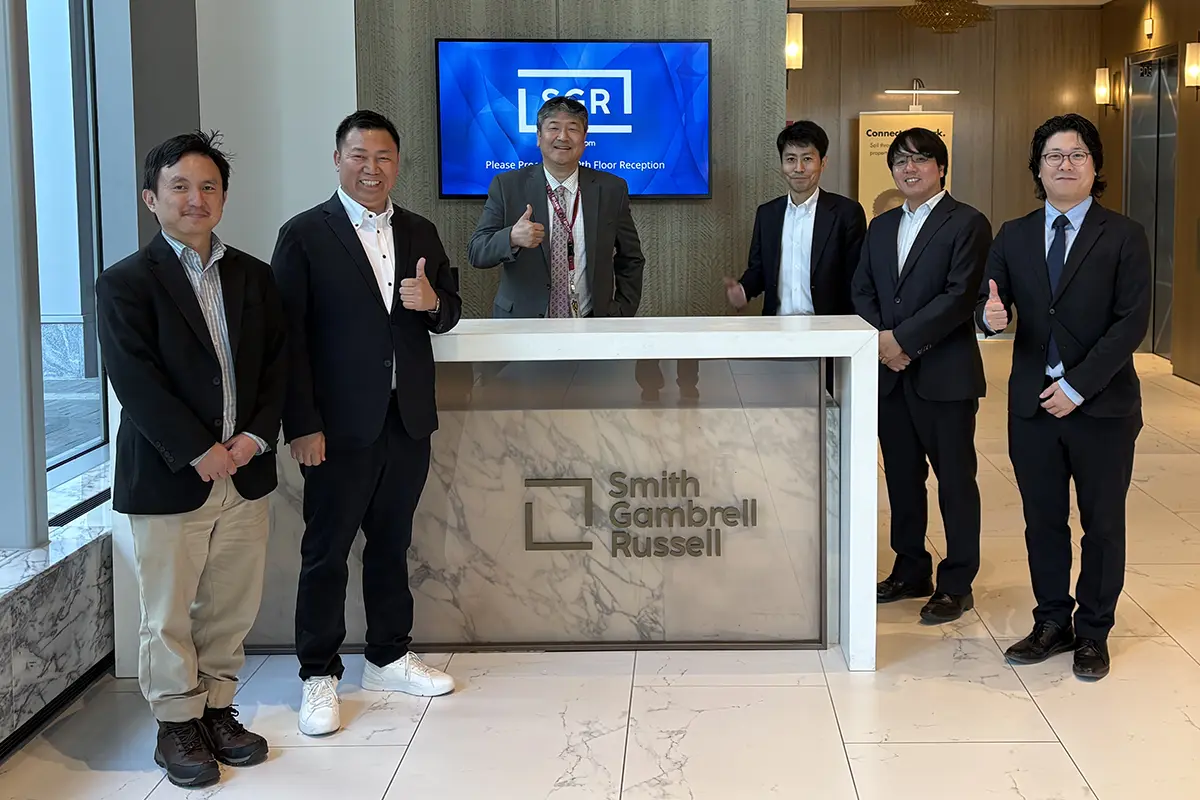
Last week, President Toyokazu Yamaguchi and Andy Huang visited the Atlanta offices of Smith, Gambrell & Russell, LLP — better known to its Japanese clients as SGR. For Mr. Yamaguchi, it was more than a courtesy call. SGR has been the quiet legal partner behind almost every consequential milestone American Katerra has reached in the United States, from the day a Japanese steel fabricator first decided to plant its flag in Texas to the trademarks that now protect its low-carbon steel products on American soil.
American Katerra is the U.S. subsidiary of Yamaguchi Heavy Industries Co., Ltd., delivering Japanese-engineered structural steel fabrication to American projects. Setting up that kind of cross-border operation is rarely a single transaction; it is a sequence of corporate, immigration, and intellectual-property decisions that have to fit together. This is where SGR has played a defining role.
A 130-Year-Old Firm with a Global Reach

Founded in 1893 in Atlanta, Georgia, Smith, Gambrell & Russell, LLP is one of the oldest full-service law firms in the American Southeast. With approximately 350 attorneys, SGR has been ranked continuously in the Am Law 200 — the annual ranking of the top U.S. law firms by revenue.
The firm operates from 15 offices in major U.S. and international markets, including Atlanta, New York, Washington D.C., Los Angeles, Chicago, Charlotte, Jacksonville, Miami, Tampa, Austin, and Houston, as well as London, Southampton, Munich, and Milan. SGR is also a member of TerraLex, an international legal network spanning more than 100 countries, 155 affiliated firms, and over 17,000 attorneys — a reach that matters when a Japanese parent and a U.S. subsidiary need to be aligned across jurisdictions.
SGR’s practice covers virtually the full corporate stack: company formation, contracts, mergers and acquisitions, joint ventures, employment and labor, litigation and dispute resolution, site selection and incentive negotiation, trade and customs, environmental, construction, real estate, intellectual property, restructuring, tax, estate planning, employee benefits, maritime, cybersecurity, and immigration. The firm runs dedicated international practices for Japanese, German, Italian, Israeli, Korean, and Chinese clients, providing legal services in their own languages.
Meet Kiyoaki “Kiyo” Kojima — Head of the Japan Practice Team

SGR’s Japan Practice Team is led by Mr. Kiyoaki “Kiyo” Kojima, a Partner in the firm’s Corporate Practice based in Atlanta. Mr. Kojima is bilingual and bicultural in Japanese, and has built his career around guiding international companies — particularly Japanese ones — into and through the U.S. market.
Originally from Odawara in Kanagawa Prefecture, Mr. Kojima moved to the United States as a child. He earned a B.A. cum laude in political science and economics from the University of Rochester, alongside a B.M. cum laude from the prestigious Eastman School of Music, where he studied bassoon. He went on to receive his J.D. from Indiana University Maurer School of Law and a Performers’ Diploma from Indiana University’s Jacobs School of Music. He has practiced law from his hometown of Atlanta since 2003 and built SGR’s Japan Practice from the ground up.
Mr. Kojima advises clients on corporate formation, governance, and compliance; mergers and acquisitions; joint ventures; secured transactions; leasing and licensing; distribution, franchise, and finance arrangements; labor and employment matters; and site selection and incentive negotiations. A meaningful share of his practice is dedicated to helping international companies relocate, operate, and establish ventures in the U.S. — exactly the situation American Katerra faced when it entered Texas.
His professional recognitions include selection to The Best Lawyers in America® for Mergers and Acquisitions Law (Atlanta, 2025–2026). He is a member of the Atlanta Bar Association, a board member of the Japan America Society of Georgia, and a board member of the Japanese Chamber of Commerce of Georgia. In Japan, he serves as an advisor or supporter for organizations such as Healthcare Innovation Hub (InnoHub), MEDISO at the Ministry of Health, Labor and Welfare, and IDEC Yokohama, and he is a registered Texas Supporter for the Tokyo Metropolitan Government’s regional economic exchange program.
How SGR Helped Build American Katerra's U.S. Foundation

SGR’s involvement with American Katerra began before the U.S. company even existed, and has continued through every major step of the build-out. Four contributions stand out.
The Introduction: Tokyo SME Support Center Hands-on Program
American Katerra’s relationship with SGR started through the Tokyo SME Support Center’s regional economic exchange program for Texas, operated by the Tokyo Metropolitan Small and Medium Enterprise Support Center (Tokyo Kosha). The program connects Tokyo-based companies expanding into Texas with vetted local supporters across business, finance, and law. As the legal supporter on the Texas roster, SGR — and Mr. Kojima personally — was introduced to the Yamaguchi Heavy Industries leadership team. That single introduction set the stage for everything that followed.
Establishing the Texas Subsidiary
Once the decision was made to set up a U.S. operation, SGR handled the corporate formation work in Texas. That meant choosing the right entity structure for a U.S. subsidiary of a Japanese parent, drafting the formation documents, navigating Texas-specific compliance, and aligning the new company’s governance with Yamaguchi Heavy Industries’ broader corporate framework. The result is the legal entity that today operates as American Katerra, LLC, the steel fabrication arm serving U.S. construction, warehouse, and industrial projects.
President Yamaguchi’s E2 Visa
A Japanese-owned U.S. subsidiary needs Japanese leadership on the ground in the United States — and that requires the right immigration status. SGR’s immigration team, working alongside the Japan Practice, prepared and supported Mr. Yamaguchi’s E2 visa application as a treaty trader/investor executive. The E2 visa allows him to live in the United States and lead American Katerra’s day-to-day operations as President, while keeping a direct line of accountability to the Japanese parent company. Without that visa work, there is no U.S.-based leadership; without U.S.-based leadership, there is no credible U.S. operation.
Protecting a Low-Carbon Brand: Green Carbon Steel™ and Blue Carbon Steel™
As American Katerra began to position itself around sustainable steel fabrication, two product brands became central to its U.S. story: Green Carbon Steel™ and Blue Carbon Steel™. Green Carbon Steel™ is the umbrella name for steel materials with significantly reduced CO₂ emissions across the supply chain; Blue Carbon Steel™ refers to steel processes that capture and reduce CO₂ through marine-linked carbon sinks. Both names had to be cleared and registered. SGR is handling the U.S. trademark filings, working with the United States Patent and Trademark Office while coordinating with the parallel registrations already secured in Japan by Yamaguchi Heavy Industries. The same trademark protections in two countries, owned by the right entities, in the right names — that is detail-heavy work, and it has been done.-
A Visit That Looks Forward, Not Back

Last week’s visit to SGR’s Atlanta office was, in part, a thank-you. It was also a working session. As American Katerra moves further into U.S. commercial growth — additional projects, new product lines under the Green Carbon Steel™ family, and a growing in-shop team — the legal questions evolve too. Customer contracts, supplier agreements, employment policies, intellectual property strategy, and ongoing immigration support are all on the table. Having a single firm that already knows the company, the parent, the leadership, and the brand makes that conversation far more efficient.
SGR’s combination of a 130-year U.S. corporate practice, a deeply experienced Japan Practice Team, and an international network through TerraLex is a rare fit for a Japanese-owned U.S. fabricator. American Katerra’s progress in Texas — the entity, the visa, the trademarks, and now a maturing operating business — would not look the way it does today without that partnership.