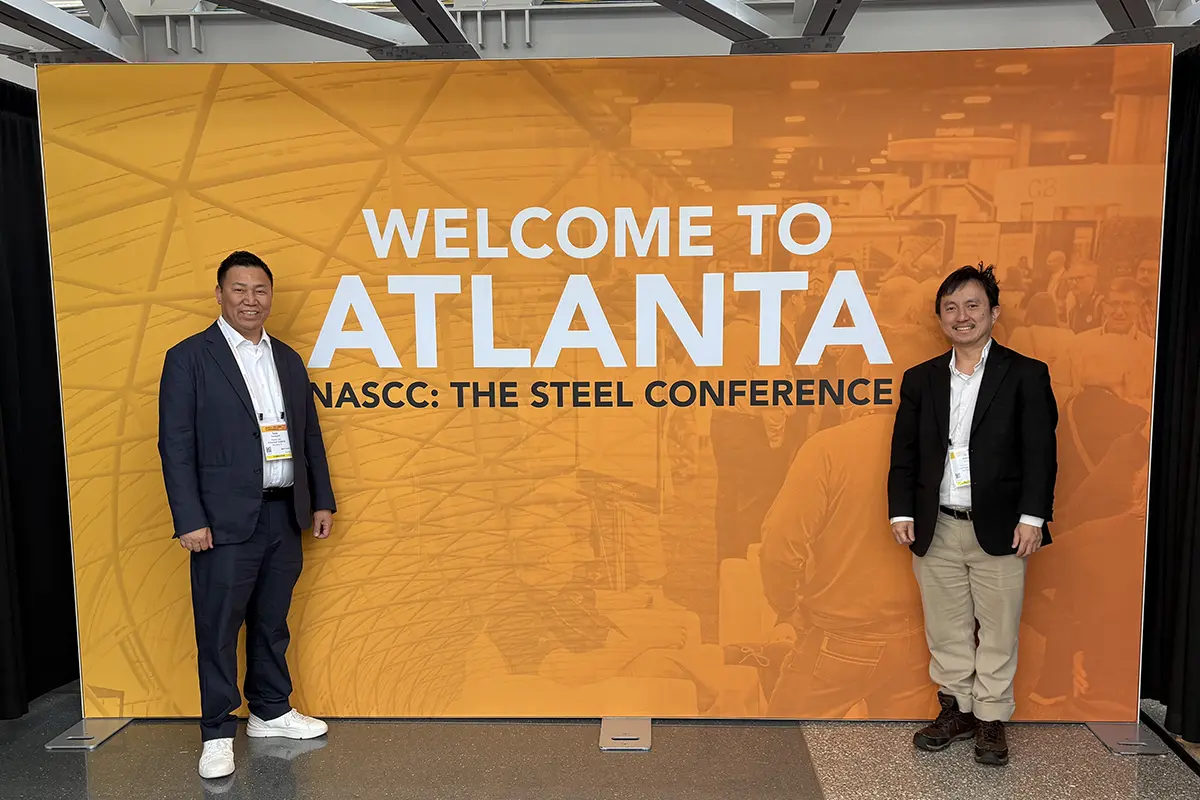
From April 20th to 24th, 2026, NASCC: The Steel Conference brought roughly 7,000 designers, fabricators, erectors, mill representatives, software vendors, and steel industry leaders to the Georgia World Congress Center in Atlanta. American Katerra was on the floor. Toyokazu Yamaguchi, President of American Katerra, LLC, and Andy Huang attended on behalf of the company, with two priorities for the trip: build relationships with the partners who keep North American steel projects moving, and understand how the latest BIM-driven software is changing the way structural steel actually gets fabricated.
This post is a short field report for our customers, partners, and prospective collaborators — a look at the connections we made, the technology that caught our attention, and what we are taking back to our shop. If you are evaluating American Katerra as a U.S. structural steel fabrication partner, this is also a window into how we think about the supply chain and production technology behind every project we deliver.
NASCC 2026: A Snapshot of the U.S. Steel Industry Under One Roof
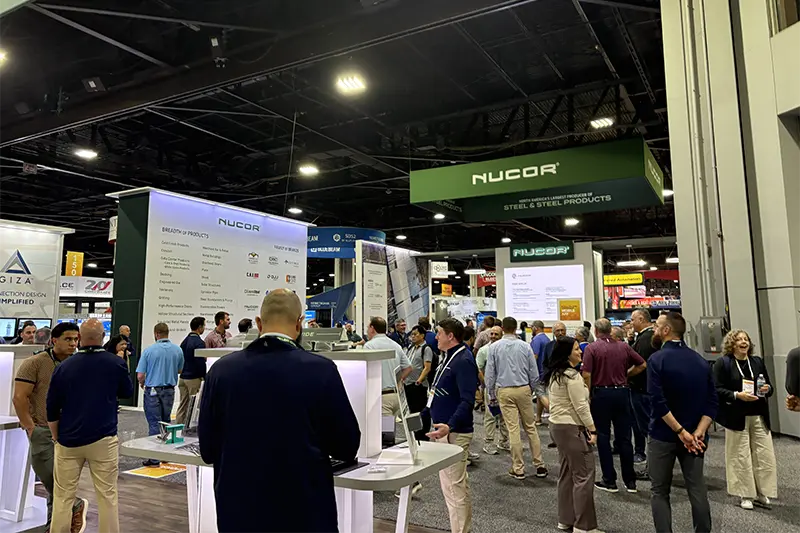
NASCC, organized by the American Institute of Steel Construction (AISC), is the largest steel construction event in North America. The 2026 edition combined the main conference with the World Steel Bridge Symposium, QualityCon, Architecture in Steel, SafetyCon, the SSRC Annual Stability Conference, and the NISD Conference on Steel Detailing — close to 300 technical sessions in total. Cold-formed steel research, full-scale seismic testing, and the ongoing CFS10 ten-story cold-formed steel building project drew strong crowds in the technical halls.
For a fabricator, though, the real work happens on the exhibit floor and at the dinners, booths, and side conversations afterward. Atlanta gave us three days of exactly that: face time with mills, service centers, robotic welding suppliers, and software developers we rely on every day.
Building New Partnerships Across the Steel Supply Chain
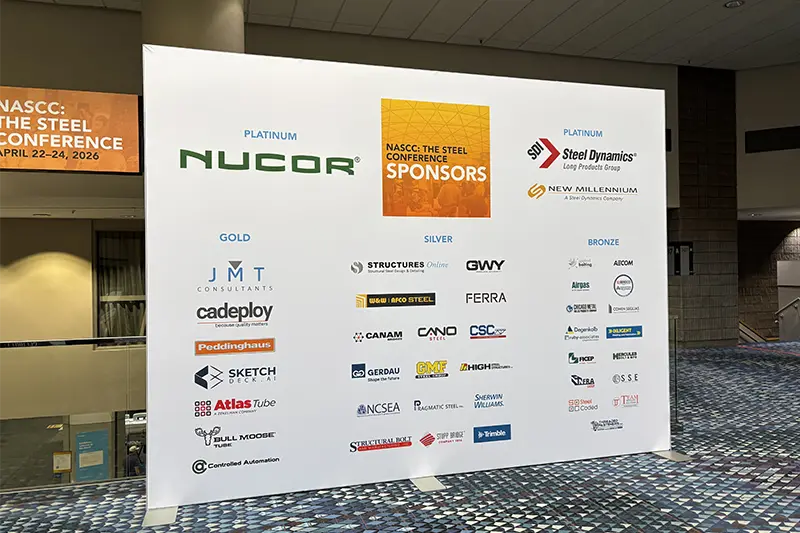
American Katerra is the U.S. arm of Yamaguchi Heavy Industries Co., Ltd., delivering Japanese-engineered structural steel fabrication to American projects. That model only works when the supply chain around us — mills, service centers, welding equipment, and software — is equally strong. Below are some of the companies we connected with in Atlanta. We are introducing them here as part of the broader ecosystem we work within; specifics of any individual conversation remain confidential.
Nucor
Headquartered in Charlotte, North Carolina, Nucor Corporation is the largest steel producer in the United States and the largest scrap recycler in North America. The company operates 26 U.S. steel mills with roughly 30 million tons of annual steelmaking capacity, plus more than 100 fabrication and downstream facilities. Nucor’s electric-arc-furnace (EAF) base, combined with its Econiq net-zero carbon steel program, makes it a key reference point for any U.S. fabrication project where embodied carbon and supply continuity matter. For American Katerra, conversations with a producer at Nucor’s scale are part of how we keep material plans realistic for our customers.
Gerdau
Gerdau Long Steel North America operates a network of EAF-based steel mills, recycling yards, and downstream facilities producing wide-flange beams, H-piling, sheet piling, merchant bar, special bar quality, and rebar for non-residential, infrastructure, and commercial construction. Gerdau’s Petersburg structural mill has reported the lowest embodied carbon for structural shapes in the U.S. based on its Environmental Product Declaration data — increasingly relevant for projects pursuing LEED v4.1 credits. As a structural steel fabricator, having a direct line to a producer this active in the long products space is meaningful.
Kobelco (Kobelco Welding of America)
Kobelco Welding of America, Inc. (KWAI), based in Houston, is the North American arm of Kobe Steel Group’s welding business. Kobelco is one of the few companies in the world that develops its own welding consumables, robotic welding systems, and welding power sources in-house. Their ARCMAN structural steel robot system is built specifically for the heavy, multi-pass welds that seismic and structural applications demand. For a fabricator backed by a Japanese parent like Yamaguchi Heavy Industries, the technical alignment with Kobelco is natural. We are watching their robotic platform closely.
Triple-S Steel
Founded in Houston, Texas in 1960, Triple-S Steel Holdings has grown into one of the largest family-owned metal service center organizations in North America, with more than 50 locations across the U.S. and Colombia. Triple-S supplies structural steel, plate, flat-rolled, pipe, tube, rebar, and processing services to construction and energy customers. For a fabricator, a service center like Triple-S provides the just-in-time material flow that protects shop schedules from mill lead-time surprises.
Delta Steel
Delta Steel, in business since 1963 and now part of The Infra Group (after originally being acquired by Reliance, Inc. in 2008), is one of the largest structural steel service centers in the United States. Delta serves customers across 17 states with structural shapes, plate, tubing, bar, and value-added processing including cambering, drilling, plate burning, press-brake forming, robotic processing, saw cutting, and T-splitting. That kind of first-stage processing capability complements the in-shop work American Katerra does on fully detailed assemblies.
The Software Reshaping the Steel Shop Floor

The technology theme of NASCC 2026 was unmistakable: BIM has already been a working part of everyday shop-floor operations for some time, and AI is now moving past marketing language into real, usable form. We spent meaningful time with four platforms and providers in particular.
Trimble — Tekla Structures and Tekla PowerFab
Trimble’s 2026 Tekla suite — Tekla Structures, Tekla Structural Designer, Tekla Tedds, and Tekla PowerFab — was front and center, with new AI capabilities, deeper Trimble Connect integration, and improved sustainability reporting. We take a closer look at Tekla PowerFab, the fabrication management piece, in a separate section below as a representative example of BIM-driven production management currently on the market.
STRUMIS
STRUMIS is a steel fabrication MRP that connects estimating, inventory, production control, purchasing, and traceability in one system. Its Estimodelling feature pulls fully connected 3D models out of Tekla Structures or SDS2 in seconds, and its production module routes work to major CNC machinery with automated time feedback from larger CNC manufacturers. Mobile and barcode tools give shop staff real-time status visibility from any device.
ALLPLAN — Steel Genie
Launched in 2026, Steel Genie is ALLPLAN’s AI-powered estimating tool. It reads a structural drawing set, identifies beams, columns, joists, and braces, and outputs quantities and an estimate-level 3D model in minutes. Connection logic is built around the AISC Design Guide, and outputs flow into ALLPLAN’s downstream detailing tools. For fabricators living in the painful gap between bid drawings and a model good enough to estimate from, this is a category-defining product to keep watching.
Spotlight: Trimble Tekla PowerFab and the BIM-to-Fabrication Pipeline

To make the BIM-to-fabrication conversation concrete, it helps to look at one of the established platforms in this category in some depth. Tekla PowerFab from Trimble is a useful illustration of what BIM-driven production management can look like once the model leaves the detailer’s screen and reaches the shop floor.
What Tekla PowerFab Is
Tekla PowerFab is Trimble’s steel fabrication management software — the operational layer that turns a Tekla Structures BIM model into purchase orders, cut lists, work orders, and production status updates. It is delivered as the Tekla PowerFab Suite, a combination of four products: Tekla PowerFab Office (the core management application), Tekla PowerFab Go (the mobile shop-floor companion), Tekla Structures (the BIM authoring environment), and Trimble Connect (the cloud collaboration platform). Together they give a fabricator one live picture of the project from estimate to ship.
Core Modules
Tekla PowerFab Office covers the full fabricator workflow: estimating, project management with scheduling, production control, material optimization, inventory control, purchasing, and order entry. Production control is its heart — a comprehensive interface for planning, managing, and tracking fabrication, with mobile tools that let shop staff view work orders and cut lists and update production status in real time.
How BIM Flows Into PowerFab
BIM is the concept; PowerFab is one of the places that data lands and gets used. A Tekla Structures model — fully connected, with member sizes, connection details, and assembly logic — flows into PowerFab so the fabricator does not re-enter quantities or geometry. From there, every downstream activity (purchasing, nesting, work-order release, status updates) is tied back to the same source-of-truth model. That single thread is what people mean when they talk about BIM-based manufacturing management: not just a 3D picture, but a data backbone the shop actually runs on.
What’s New in the 2026 Release
Rather than walk through every feature note from the 2026 release, the more useful observation is the direction the category appears to be heading. The updates we saw point in three directions: more granularity at the workstation level (so shop staff see only what is relevant to their station), validation gates before shipment, and simpler reporting around recycled content and material origin tied to project sustainability requirements. Connectivity with the wider project-management and financial stack — in Trimble’s case, Trimble Connect, ProjectSight, and Viewpoint Vista — is also being treated as standard rather than optional. None of these are unique to a single product; they describe where production management for steel fabrication is going as a category.
Why This Matters for Fabricators (and Their Customers)
Production-management platforms in this category, including Tekla PowerFab and STRUMIS, are meaningful for two reasons. First, they shorten the distance between design intent and fabricated reality — when a beam changes in the model, the consequences for purchasing, cutting, welding, and shipping cascade through one system instead of being rebuilt by hand in spreadsheets. Second, they give general contractors and project owners honest visibility: real-time production status, validated shipment readiness, and auditable LEED documentation, not best-effort updates over email.
What This Means for American Katerra's Customers

Walking out of Atlanta, three things are clear for the work we do with U.S. customers. First, the U.S. structural steel supply chain has depth — between Nucor and Gerdau on the mill side, Triple-S Steel and Delta Steel as service centers, and Kobelco as a robotic welding partner, a fabricator like American Katerra has more than enough surface area to design supply strategies project by project. Second, BIM-based fabrication management is increasingly serving as the operating system for shops that want to be honest about schedule and cost, though the specific platform that fits each fabricator varies. Third, the AI layer (Steel Genie, the AI features in Tekla 2026) is moving fast enough that estimating and detailing workflows in 2027 will look meaningfully different from those in 2025.
American Katerra’s commitment is to combine the precision discipline our parent company Yamaguchi Heavy Industries built over decades in Japan with the supply-chain depth and production technology now available in the U.S. NASCC 2026 reinforced both halves of that commitment.
Talk to American Katerra
If you are evaluating a structural steel fabrication partner in the U.S., or want to compare notes on BIM-driven production workflows, we would like to hear from you. Reach out through our contact page to see how American Katerra delivers Japanese-engineered structural steel fabrication on American projects.