

In October 2025, at the HSS Summit held in Texas, Kobe Steel and Yamaguchi Heavy Industries delivered a joint presentation titled “Beyond Borders: How International Methods Inspire Nontraditional Design Wins.” This session delved into Japan’s longstanding adoption of Hollow Structural Sections (HSS) in steel-frame architecture, the supporting welding robot technologies, and American Katerra, LLC’s strategy for bringing these innovations to the U.S. market.
The global construction industry faces a triple challenge: a shortage of skilled labor, increasingly stringent quality standards, and growing demands for sustainability. This report explores how Japan’s “smart factory” approach offers concrete solutions to these issues and how it is poised to establish new standards in the U.S. market.
HSS's Dominant Position in Japanese Steel Architecture and Its Foundations
The Current State of HSS in Japan’s Structural Steel Market
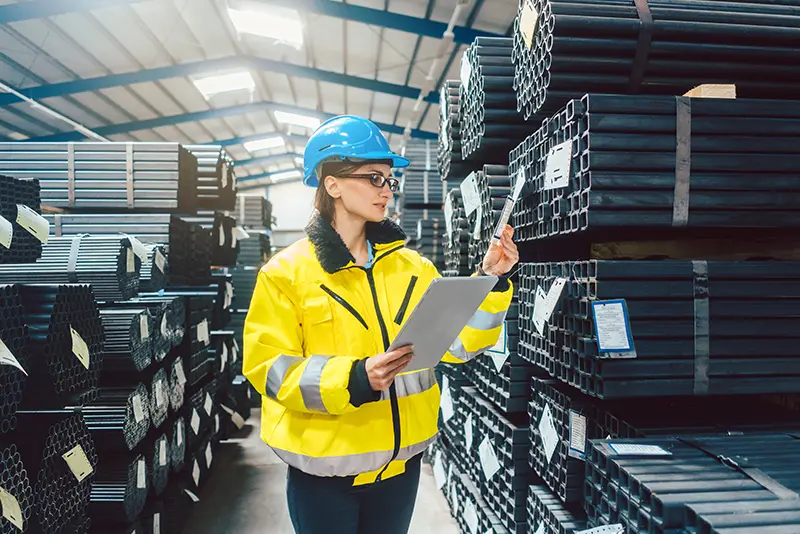
In Japan’s steel-frame building market, the combination of HSS columns and H-beams accounts for an overwhelming 70% to 80% of structural types. This starkly contrasts with the North American market, where wide-flange (H-shaped) steel columns represent only 5% to 10%. This heavy reliance on HSS stems from Japan’s unique geographical and regulatory requirements.
Design Advantages of HSS
The primary reason HSS has become mainstream in Japan lies in its superior structural performance and design flexibility.
- Seismic Performance and Bending Moment Resistance: As an earthquake-prone nation, Japan demands exceptionally high seismic resilience from its buildings. HSS columns lack the “weak axis” found in wide-flange columns, providing uniform high bending moment resistance in all directions, ensuring structural stability.
- Design Flexibility and Space Efficiency: Adopting HSS eliminates the need for braces, enhancing structural design flexibility. This allows for slimmer columns and wider interior spaces, maximizing floor area and optimizing construction costs.
Beam-Through Type HSS Columns and Fabrication Challenges
To maximize HSS’s strengths, Japan widely employs the beam-through joint method, where beams penetrate the columns and are welded. This enhances joint rigidity but introduces challenges: numerous weld points and complex joint shapes, leading to moderate to high levels of welding volume and complexity.
Welding Automation – A Breakthrough in Overcoming HSS Fabrication Challenges
Introduction of Welding Automation
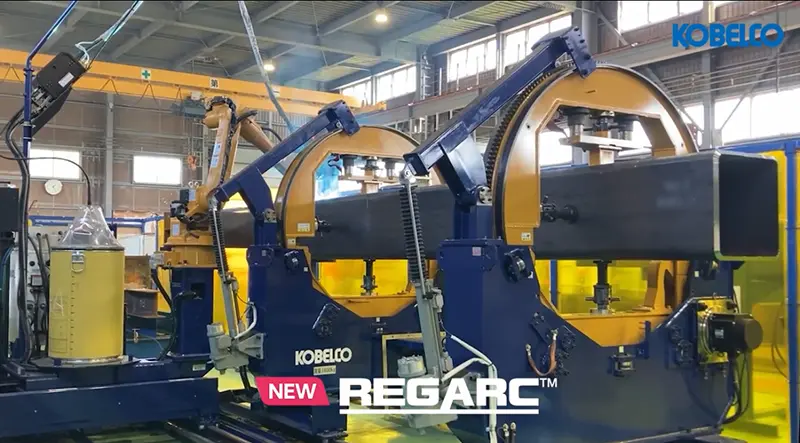
Since the 1980s, Japan’s steel industry has responded to rising HSS demand and the aging/shortage of skilled welders by aggressively adopting welding robot systems like ARCMAN™. This “welding automation” resolves the paradox between HSS’s design advantages and its fabrication complexities.
Core Functions of Robots in Smart Factories
The welding robot systems utilized in Yamaguchi Heavy Industries’ smart factories are not mere automations but intelligent platforms.
- CAD Data Integration and Automated Teaching: Traditional manual teaching of weld paths, which took skilled workers hours, is now automated via 3D CAD data, generating weld routes and conditions directly. This drastically reduces preparation time, enabling immediate production.
- Quality Stabilization (Achieving QMS): Robots maintain consistent weld conditions and speeds without fatigue or variability, eliminating inconsistencies in multi-layer welding and ensuring human-independent high quality.
- Add-On Features for Extended, Continuous Operation: Functions like automatic slag removal, nozzle exchange, and tip replacement allow robots to operate non-stop, including overnight, dramatically boosting overall factory productivity.
Economic Benefits of Automation
Welding automation delivers economic advantages in several ways:
- Labor Cost Optimization and Productivity Gains: It enables workforce reduction and reallocates skilled labor to higher-level management tasks.
- Supply Chain Efficiency: Precise, structured production schedules enable lean manufacturing, shortening lead times across the supply chain.
- Overall Structural Optimization: Promoting HSS use minimizes material thickness ratios from foundations upward, achieving building lightweighting and cost efficiencies.
Yamaguchi Heavy Industries' Smart Factory Strategy and Global Expansion
Yamaguchi Heavy Industries (YHI)’s Philosophy and Achievements
Founded in 1949, Yamaguchi Heavy Industries has upheld the motto “Beyond the Information Revolution: Bringing Happiness Through Production Innovation,” consistently incorporating cutting-edge technologies. With an annual steel fabrication capacity of approximately 15 million kg, the company handles diverse projects, from complex structures like the Kyushu National Museum to large-scale logistics facilities.
Enhancing Operational Efficiency Through DigitalTransformation (DX)
In addition to robot automation, our company advances Digital Transformation (DX), enabling real-time monitoring of production status and output across factories. This “visualization” supports further lean production and swift management decisions.
Growth Strategy: From Japan to the U.S.
Our business strategy, powered by welding automation, unfolds in two phases:
- Domestic Strengthening (Through 2030): Based on our mid-term plan, we will expand domestic factories and add welding robots to establish a nationwide supply system in Japan.
- Full U.S. Market Entry (From 2026 Onward): In 2024, we established American Katerra, LLC in the U.S., preparing for entry into the Texas market. Plans include opening a smart factory equipped with welding robot systems in San Antonio, Texas, by January 2028.
Commitment to Sustainability
American Katerra, LLC aims to establish next-generation standards in the U.S. market, beyond mere steel supply.
- Promoting “Green Carbon Steel™“: A trademark-pending term for steel and products with significantly reduced CO2 emissions across the supply chain from manufacturing to our fabrication processes.
- Promoting “Blue Carbon Steel™“: Similarly, a trademark-pending concept for low-CO2 steel.
- LEED-Certified Factory: The new San Antonio facility will adopt LEED certification standards for sustainable manufacturing environments.
Conclusion – International Technology Exchange Paving the Way for HSS in the U.S.

The Japanese HSS fabrication techniques and welding automation expertise presented offer immediate solutions to the U.S. market’s challenges with skilled labor shortages and production efficiency.
As President Yamaguchi stated, “Combining Japan’s advanced technologies with the world’s leading U.S. HSS manufacturing and local fabricators’ robot automation will unlock the full potential of HSS in the U.S. market.”
Through the San Antonio smart factory, American Katerra, LLC will introduce high-quality, high-efficiency, and sustainable steel fabrication concepts to the U.S., fostering new design paradigms and transforming the construction industry.